
How Profit and Loss Are Calculated on Quotex
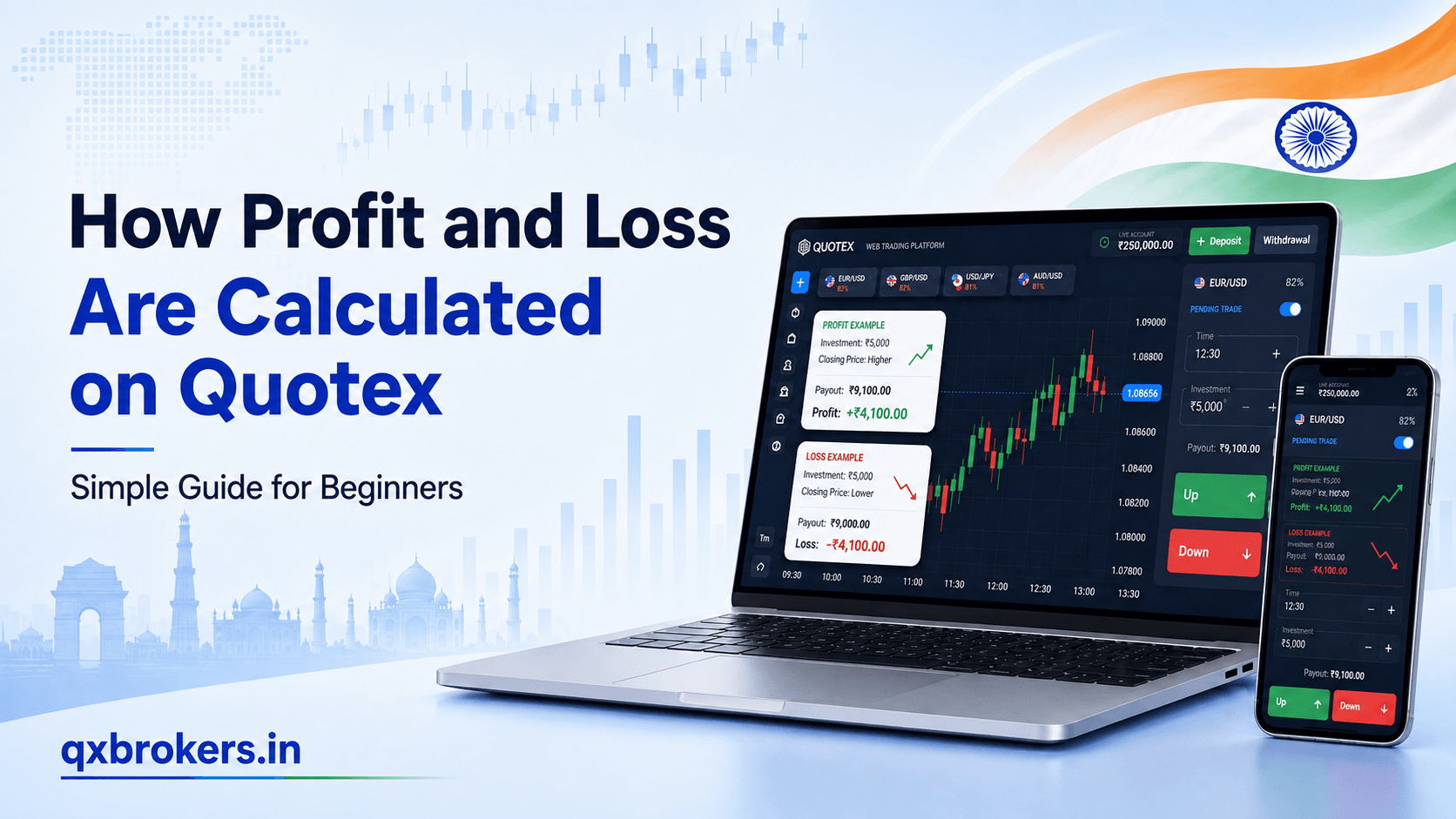
Table of Contents
- Quotex Profit Formula
- How a Winning Trade Is Determined
- How a Losing Trade Is Calculated
- What If the Price Does Not Change?
- Why the Payout Percentage Changes
- Does a Larger Price Move Mean More Profit?
- Which Price Does Quotex Use?
- Break-Even Win Rate
- FAQs
- Final Summary
When you open a trade on Quotex, the result depends on three main factors: the direction you select, the asset’s opening and expiry prices, and the payout percentage shown before you confirm the trade. If your prediction is correct at expiry, you receive your original trade amount plus the stated profit. If it is wrong, you lose the amount invested in that trade. If the opening and expiry prices are exactly equal, the platform’s FAQ says the investment is returned.
Quotex calculates a trade result by comparing the asset price at opening with its price at the selected expiry time.
- Choose Higher when you expect the price to finish above the opening price.
- Choose Lower when you expect it to finish below the opening price.
- A correct prediction produces a fixed profit based on the displayed payout.
- An incorrect prediction generally loses the trade amount.
- If the price closes at exactly the opening level, the official FAQ describes the result as zero and says the investment is returned.
The size of the movement does not normally change the fixed payout. A one-point move in the correct direction can produce the same stated return as a much larger move.
HOW TO REGISTER ON QUOTEX IN INDIA
Quotex Profit Formula
The profit on a successful trade is calculated as:
Profit = Trade amount × Payout percentage
The total amount credited is:
Total return = Trade amount + Profit
For example, suppose you place a ₹1,000 trade and the platform displays an 85% payout.
Profit: ₹1,000 × 85% = ₹850
Total return: ₹1,000 + ₹850 = ₹1,850
The ₹1,850 includes your original ₹1,000 and ₹850 in net profit. Quotex’s FAQ says the profit percentage is displayed before the trade, while its Service Agreement defines the payout factor as the percentage used to determine income.
How a Winning Trade Is Determined
A trade succeeds when the price moves in the direction selected by the expiry time.
“Higher” example
- Opening price: 1.10500
- Direction: Higher
- Expiry price: 1.10510
- Result: Successful
The price finished above the opening level, so the prediction was correct.
“Lower” example
- Opening price: 2,450.00
- Direction: Lower
- Expiry price: 2,449.50
- Result: Successful
Because the expiry price was below the opening price, the “Lower” prediction was correct. The Service Agreement identifies “Higher” and “Lower” as essential trade conditions and states that a trade closes at its agreed expiry time.
How a Losing Trade Is Calculated
A trade loses when the price finishes in the opposite direction.
Suppose you invest ₹500 with an 80% payout and choose “Higher.” If the asset closes below its opening price, the ₹500 trade amount is lost.
Maximum trade loss = Amount invested in that trade
The possible ₹400 profit is not an extra loss because it was never credited. This is why payout and risk should not be confused: an 80% payout may generate ₹400 on a successful ₹500 trade, while an unsuccessful trade can lose the full ₹500.
What If the Price Does Not Change?
A zero-price movement is an important result that many short explanations overlook.
According to the official Quotex FAQ, if the expiry price is exactly the same as the opening price, the trade has a zero outcome and the investment is returned.
Example:
- Trade amount: ₹1,000
- Opening price: 100.250
- Expiry price: 100.250
- Amount returned: ₹1,000
- Net result: ₹0
Some simplified explanations incorrectly describe an unchanged price as a loss. The platform’s current FAQ instead describes it as a zero result, so always check the latest official terms in case the rules change.
Why the Payout Percentage Changes
The payout is not always identical for every asset or at every time. Quotex says profit size can be affected by asset liquidity, trade time, brokerage tariffs and market changes. Its Service Agreement says the payout factor depends on the underlying asset and other trade conditions.
One asset may show an 85% payout while another shows 70%. The same asset may also display a different percentage later. Always check the current payout on the trade ticket before confirming the position.
Does a Larger Price Move Mean More Profit?
No. In a fixed-payout digital-options trade, the distance moved generally does not increase the stated return.
If you select “Higher,” a small increase and a large increase can produce the same profit, provided both finish above the opening level at expiry. The key questions are:
- Was the direction correct?
- What payout was displayed?
- How much was invested?
This differs from conventional asset trading, where profit may grow as the market moves farther from the entry price. Quotex’s FAQ states that the fixed profit does not depend on how far the price moves in the predicted direction.
Which Price Does Quotex Use?
The result is based on the quote recorded in the Quotex trading terminal at opening and expiry. The Service Agreement says the asset rate is determined using information such as central banks, trading venues and liquidity providers. It also says the company’s server records requests and results, and its log records may prevail during a dispute.
A price shown on another charting service may therefore not match the platform exactly because of different data providers, timing or rounding. With short expiry periods, even a small difference can change the result.
Break-Even Win Rate
Because a losing trade can cost more than a winning trade earns when the payout is below 100%, the required break-even win rate is above 50%.
Break-even win rate = 1 ÷ (1 + payout rate)
At an 80% payout:
1 ÷ 1.80 = 55.56%
You would need to win about 56 out of 100 equal-sized trades to reach the approximate break-even point, before considering any other costs or operational factors.
For example, across 100 trades of ₹100 each:
- 56 successful trades earning ₹80 each produce ₹4,480.
- 44 unsuccessful trades losing ₹100 each produce a ₹4,400 loss.
- Approximate net result: ₹80 profit.
At only 50 successful trades, the profit would be ₹4,000 while the losses would total ₹5,000, producing a ₹1,000 net loss.
FAQs
How does Quotex calculate profit?
Multiply the trade amount by the payout percentage displayed before confirmation. A ₹1,000 trade with an 80% payout would produce ₹800 in net profit if the prediction is successful.
How much can I lose on one trade?
For a standard unsuccessful trade, the loss is generally the amount invested in that trade. A ₹500 trade would therefore have a maximum standard trade loss of ₹500.
Is the investment included in the total return?
Yes. A successful total return includes the original trade amount plus the profit. If you invest ₹1,000 at an 85% payout, the total return is ₹1,850, but the net profit is ₹850.
What happens if both prices are equal?
The official Quotex FAQ says the result is zero and the original investment is returned.
Does volatility increase the fixed profit?
Not directly. Volatility may influence price movement and the payout offered, but the confirmed trade uses the payout displayed when the trade is placed.
Can the payout change before I place a trade?
Yes. The displayed percentage may vary according to the asset, time and other trade conditions. Review the current percentage immediately before confirming the trade.
Final Summary
Quotex calculates profit and loss using the selected direction, opening price, expiry price, trade amount and displayed payout. A correct forecast earns a fixed percentage, an incorrect forecast loses the invested amount, and an unchanged price is described by the official FAQ as a zero result with the investment returned.
Always verify the payout before placing a trade, understand the break-even win rate and avoid risking money you cannot afford to lose. Platform terms, percentages and regulatory conditions can change, so review current official information before making a decision.
Risk warning: Digital-options trading involves a high risk of losing money. This content is for general educational purposes and is not financial or investment advice.