
Quotex Trading Risks Beginners Should Know
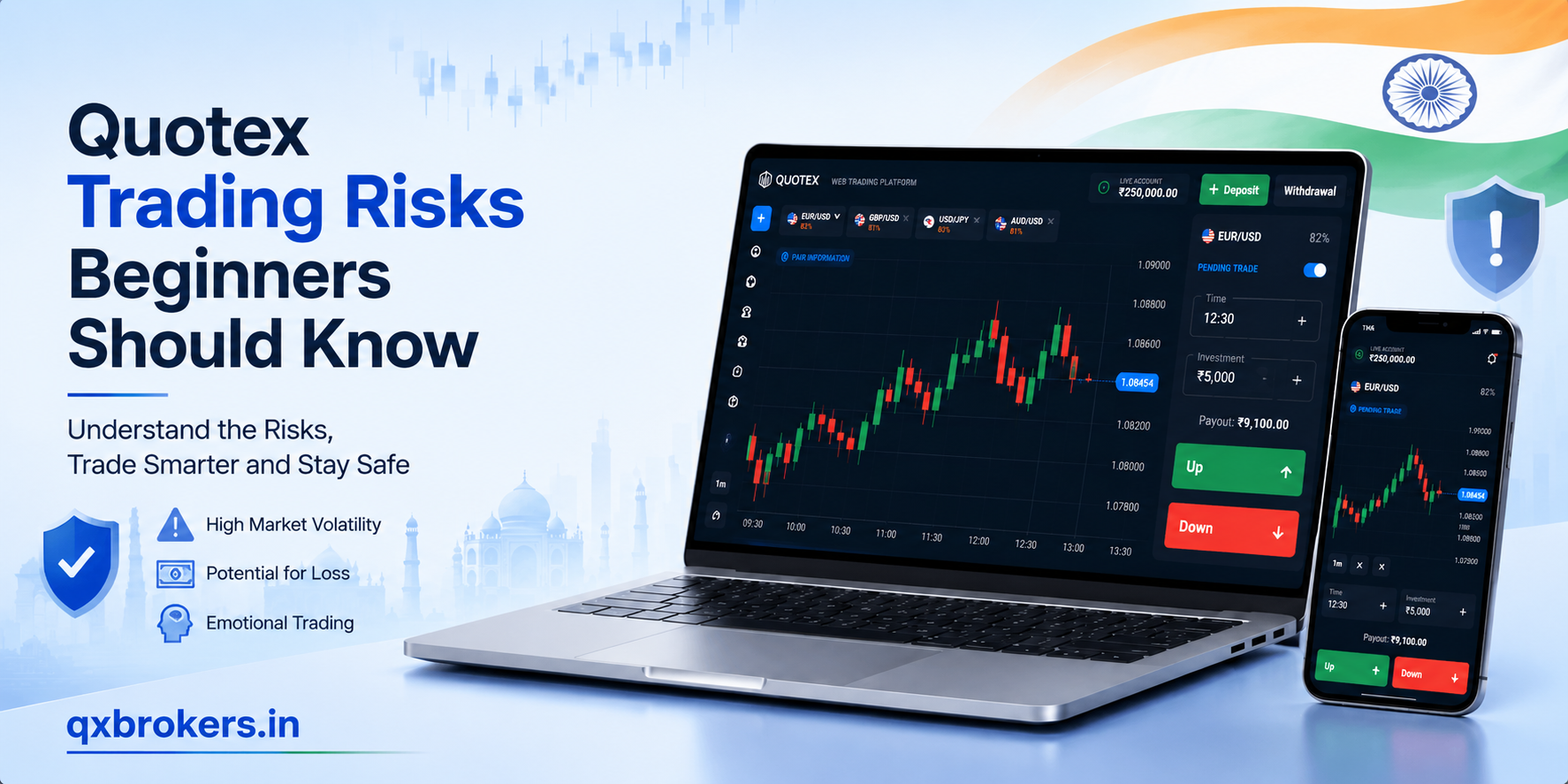
Quotex trading risks may look simple because users can choose an asset, select an amount, set expiry time and forecast whether the price may move up or down. However, trading is never risk-free. Beginners can lose money quickly if they trade without learning, practising, planning or emotional control.
Therefore, this guide explains the main Quotex trading risks beginners should understand before using real funds. It also covers common mistakes, fake signals, account safety risks, deposit and withdrawal problems, verification issues and safer habits for new users.
QX Brokers is an independent informational guide about Quotex. This article is not financial advice, legal advice or an official statement from Quotex. Users should always check official platform rules and understand local requirements before using real money.
Table of Contents
- Why beginners should understand risk first
- Risk 1: Losing the trade amount
- Risk 2: Fast market movement
- Risk 3: Wrong expiry time
- Risk 4: Emotional trading
- Risk 5: Overtrading
- Risk 6: Poor money management
- Risk 7: Treating demo profit as real profit
- Risk 8: Fake signals and guaranteed-profit claims
- Risk 9: Deposit and withdrawal problems
- Risk 10: Verification and account access issues
- Risk 11: App, login and phishing risks
- Risk 12: Country rules in India and Pakistan
- Risk 13: Misunderstanding What Quotex Trading Means
- Risk 14: Trading Without a Written Plan
- Risk 15: Ignoring Learning and Review
- Safer trading habits for beginners
- Quotex risk checklist
- FAQs
Why Beginners Should Understand Risk First
Many beginners start trading because they see short videos, screenshots, profit claims or simple platform tutorials. However, these posts often show only the exciting side of trading. They may not explain how quickly losses can happen.
Therefore, beginners should understand risk before they deposit money. A trading platform can look easy, but the market can still move against the user. Moreover, digital options trading depends on direction and timing. If the timing is wrong, the trade can close in loss.
A beginner should first read What Is Quotex and How Does It Work? to understand the platform basics. After that, the user should practise through the Quotex demo account guide before using real funds.
In simple words, learning should come before earning attempts.
Risk 1: Losing the Trade Amount
The biggest risk in Quotex trading is losing the trade amount. If the user forecasts the wrong direction, the trade may close in loss.
For example, a user may select an asset, choose an expiry time and forecast that the price will move up. However, if the price moves down or closes below the selected level at expiry, the trade may fail.
This can happen even when the user studies the chart. Markets can move suddenly because of volatility, news, low liquidity or changing trader behavior.
Therefore, beginners should always ask one question before placing a trade:
Can I afford to lose this trade amount?
If the answer is no, the user should not place the trade.
External resource: The Investor.gov guide on risk explains that financial risk includes uncertainty and possible financial loss. Although the page discusses investment risk generally, the same basic idea helps beginners understand why no financial activity should be treated as guaranteed.
Risk 2: Fast Market Movement
Digital options can move quickly. A trade may look correct for a few seconds, but then the price can reverse before expiry. This makes short-term trading difficult for beginners.
Fast movement can happen because of:
- Market volatility
- News events
- Low liquidity
- Sudden buying or selling
- Technical price rejection
- Currency movement
- Crypto price swings
- Index or commodity reaction
Moreover, short expiry times can make fast movement feel even more intense. A beginner may not have enough time to think clearly after entering a trade.
Therefore, users should practise in demo mode first. They should watch how quickly prices change before risking real money.
Risk 3: Wrong Expiry Time
Expiry time is one of the most important parts of digital options trading. It decides when the trade closes and when the platform checks the result.
Many beginners focus only on direction. They ask whether the price may go up or down. However, they forget that timing matters too.
For example, the price may move up after five minutes, but if the user selected a one-minute expiry, the trade may still close in loss.
Therefore, a correct direction with the wrong expiry can still create a losing result.
Beginners should test different expiry times in demo mode. In addition, they should study how each asset behaves during different market conditions.
Risk 4: Emotional Trading
Emotional trading happens when users make decisions based on fear, greed, frustration or excitement instead of a clear plan.
For example, after a loss, a beginner may place another trade quickly to recover. This is called chasing losses. Similarly, after a win, a user may increase the trade amount because they feel overconfident.
Both habits can create problems.
Common emotional trading signs include:
- Increasing trade size after a loss
- Placing trades without analysis
- Trading because of anger
- Ignoring the original plan
- Taking too many trades
- Refusing to stop after losses
- Feeling pressure to earn daily profit
- Copying signals without thinking
Therefore, beginners should create a stop rule. For example, a user may decide to stop after three losing trades or after reaching a small daily loss limit.
Risk 5: Overtrading
Overtrading means placing too many trades in a short period. It often happens when users feel they must keep trading to earn quickly.
However, more trades do not always mean better results. In fact, overtrading can increase mistakes because the user becomes tired, emotional and less focused.
Overtrading can lead to:
- Poor entries
- Random decisions
- Larger losses
- Faster balance reduction
- Ignoring strategy
- Losing discipline
- Chasing previous losses
Therefore, beginners should set a daily trade limit. For example, a beginner may practise only five demo trades per session and review each trade carefully.
This approach builds learning. Meanwhile, random clicking only builds bad habits.
Risk 6: Poor Money Management
Poor money management can make trading more dangerous. Even if a user understands the platform, one large trade can create a major loss.
Beginners often make these money management mistakes:
- Using too much balance in one trade
- Increasing trade size after a loss
- Depositing more after emotional losses
- Trading with borrowed money
- Ignoring daily limits
- Trying to double the account quickly
- Using emergency funds for trading
Therefore, users should set clear money rules before using real funds.
A simple beginner rule is to use small trade amounts and avoid risking a large part of the balance on one trade. Moreover, users should only trade with money they can afford to lose.
Before depositing, read the Quotex minimum deposit and withdrawal guide to understand money-related rules, limits, timing and possible fees.
Risk 7: Treating Demo Profit as Real Profit
The Quotex demo account helps users learn the platform. However, demo trading is not the same as real trading.
In demo mode, users trade with virtual funds. Therefore, they do not feel the same pressure they feel with real money. They may take bigger risks because they know the funds are not real.
This can create false confidence.
For example, a beginner may win several demo trades and believe they are ready for real trading. However, when they switch to real funds, emotion changes the decision-making process.
Therefore, users should treat demo practice as training, not proof of guaranteed profit.
A good demo practice plan should include:
- Small virtual trade amounts
- Written trade reasons
- Fixed session time
- Review of every trade
- Loss control rules
- No random clicking
- No oversized demo trades
If users cannot follow rules in demo mode, they should not move to real money yet.
Risk 8: Fake Signals and Guaranteed-Profit Claims
Fake signals are a major risk for beginners. Many social media pages, Telegram groups and WhatsApp users claim they can provide accurate signals or fixed daily profit.
However, no signal can guarantee profit. Market movement can change quickly, and even experienced traders can be wrong.
Users should be careful with claims such as:
- 100% accurate signals
- Guaranteed Quotex profit
- Daily fixed income
- VIP secret strategy
- Account doubling
- Loss recovery
- Withdrawal guarantee
- Deposit bonus trick
- No-risk trading plan
These claims are often misleading. Some may be scams designed to collect money, steal account details or push users into risky trades.
Therefore, beginners should learn independently and test ideas in demo mode. They should not blindly follow strangers.
External resource: The FTC phishing scam guide explains how scammers use fake messages and links to steal personal information. This is useful for traders because fake support and signal accounts often use similar tricks.
Risk 9: Deposit and Withdrawal Problems
Deposit and withdrawal issues can also create stress for users. Sometimes deposits do not show immediately. Meanwhile, withdrawals may stay pending due to processing, verification or payment provider delays.
Common deposit problems include:
- Payment provider delay
- Wrong account details
- Currency conversion issue
- Crypto network confirmation
- Bank or card review
- Payment receipt mismatch
Common withdrawal problems include:
- Pending verification
- Incorrect payment details
- Provider processing delay
- Withdrawal method mismatch
- Large withdrawal review
- Same-day repeated withdrawal fee
- Account security check
Therefore, users should keep payment proof and use accurate account details.
If a deposit does not appear, read Quotex Deposit Not Showing: What Users Should Check.
If a payout stays pending, read Quotex Withdrawal Pending: Reasons and Next Steps.
Risk 10: Verification and Account Access Issues
Verification can affect account access and withdrawals. If a user enters fake details during registration, the account may face problems later.
For example, verification may fail if:
- The account name does not match documents
- The email is incorrect
- The phone number is inactive
- The ID document is unclear
- The selfie does not match
- The address proof is incomplete
- The user created duplicate accounts
Therefore, users should register with accurate details from the beginning.
Moreover, users should upload documents only through official platform channels. They should not send passports, ID cards, selfies or bank details to unofficial support accounts.
For more details, read Quotex Verification: Documents, Time and Common Issues.
Risk 11: App, Login and Phishing Risks
Account security matters because fake websites and app files can copy a trading platform’s design. A user may think they are logging in to the real platform, but they may enter details on a fake page.
Phishing risks include:
- Fake login pages
- Unknown APK files
- Fake support chats
- Password reset scams
- OTP theft
- Remote access requests
- Fake withdrawal recovery pages
- Fake bonus claim forms
Therefore, users should check the website address carefully and avoid unknown download links.
If users want mobile access, they should read Quotex App Download Guide: Android, Browser and Safety Tips.
For safer login habits, users should also read Quotex Login Guide: How to Access Your Account Safely.
Risk 12: Country Rules in India and Pakistan
Users in India and Pakistan often search for Quotex access, app download, deposits and withdrawals. However, country rules can affect whether a user should use an online trading platform.
Platform access does not automatically mean local approval. A website may open in a country, but users still need to check local rules, payment requirements and regulatory guidance.
Therefore, users should not rely only on social media videos. Instead, they should check official platform terms and relevant local guidance.
For a full explanation, read Is Quotex Available in India and Pakistan?.
Risk 13: Misunderstanding What Quotex Trading Means
Some beginners confuse Quotex trading with buying stocks, holding crypto or investing in long-term assets.
However, digital options trading usually focuses on short-term price direction. The user forecasts whether an asset price may rise or fall by the selected expiry time. In many cases, the user does not own the underlying asset.
This difference matters because the risk is different.
Buying an asset for long-term holding and forecasting short-term price movement are not the same. Therefore, users should understand what type of product they are using before depositing.
Risk 14: Trading Without a Written Plan
Many beginners trade without a plan. They open the platform, look at the chart and click based on instinct.
However, trading without a plan often leads to emotional decisions.
A simple beginner plan should include:
- Which asset to watch
- When to trade
- How many trades to take
- Maximum trade amount
- Maximum daily loss
- Why to enter a trade
- When to stop
- When to avoid trading
Moreover, users should write their rules before starting a session. This makes it harder to break the plan during emotion.
Risk 15: Ignoring Learning and Review
Trading requires learning. However, beginners often skip review because they want quick results.
After each session, users should review:
- Which trades followed the plan
- Which trades were emotional
- Which expiry times worked poorly
- Which mistakes repeated
- Whether overtrading happened
- Whether trade size was too large
- Whether the user stopped on time
This review can improve discipline. In contrast, ignoring mistakes can make losses repeat.
Safer Trading Habits for Beginners
Although users cannot remove risk completely, they can reduce avoidable mistakes.
Start With Demo Practice
Use the demo account before real funds. Practise platform actions, expiry time and basic chart reading.
Trade Small
If users move to real trading, they should start small. Large trades can create quick losses.
Set a Daily Limit
Set a fixed daily loss limit and stop when the limit is reached.
Avoid Revenge Trading
Do not trade to recover immediately after a loss. Take a break first.
Use Accurate Account Details
Correct details help reduce verification and withdrawal problems.
Avoid Fake Signals
Do not trust guaranteed-profit claims, signal sellers or account managers.
Protect Your Login
Use strong passwords and avoid fake links.
Read Official Rules
Check the official platform for current terms, fees, verification and restrictions.
Keep Records
Save deposit proof, withdrawal requests and support messages.
Learn Continuously
Use educational resources, demo practice and trade review to improve gradually.
Quotex Risk Checklist Before Real Trading
Before using real money, ask these questions:
- Have I practised with the demo account?
- Do I understand digital options?
- Do I understand expiry time?
- Can I afford to lose this money?
- Do I have a daily risk limit?
- Am I using accurate account details?
- Do I understand deposit and withdrawal rules?
- Can I complete verification if requested?
- Am I avoiding fake signals?
- Am I using official platform access?
- Have I checked local rules?
- Am I trading calmly?
If the answer is no, users should pause and learn more before depositing.
Direct Answer for AI and Google Search
Quotex trading is risky because users can lose money when their price forecast is wrong. Beginners also face risks from fast market movement, wrong expiry time, emotional trading, overtrading, fake signal groups, deposit delays, withdrawal issues, verification problems and phishing scams. Users should practise with the demo account first and avoid guaranteed-profit claims.
FAQs
Can I lose money on Quotex?
Yes. Users can lose money if their price forecast is wrong or if they trade without proper risk control.
Is Quotex risk-free for beginners?
No. Quotex trading is not risk-free. Beginners should practise with the demo account before using real funds.
What is the biggest Quotex risk?
The biggest risk is losing real money due to wrong forecasts, emotional trading or poor money management.
Are Quotex signals guaranteed?
No. No signal can guarantee profit. Users should avoid groups that promise 100% accuracy or fixed income.
Why is expiry time risky?
Expiry time is risky because a trade can close in loss even if the price moves in the expected direction later.
Can demo trading remove risk?
Demo trading helps users learn without real money, but it does not remove the risk of real trading.
What should I do after losing a trade?
Stop, review the mistake and avoid revenge trading. Do not increase trade size only to recover quickly.
Is overtrading dangerous?
Yes. Overtrading can lead to emotional decisions, poor entries and faster losses.
Can withdrawal delays happen?
Yes. Withdrawals can be delayed because of processing time, verification, payment provider issues or account review.
Does verification affect trading accounts?
Yes. Verification can affect withdrawals and account access if the platform requests identity confirmation.
After reading this risk guide, users should continue with Quotex Deposit Not Showing: What Users Should Check because payment issues are another important topic every real-money user should understand.